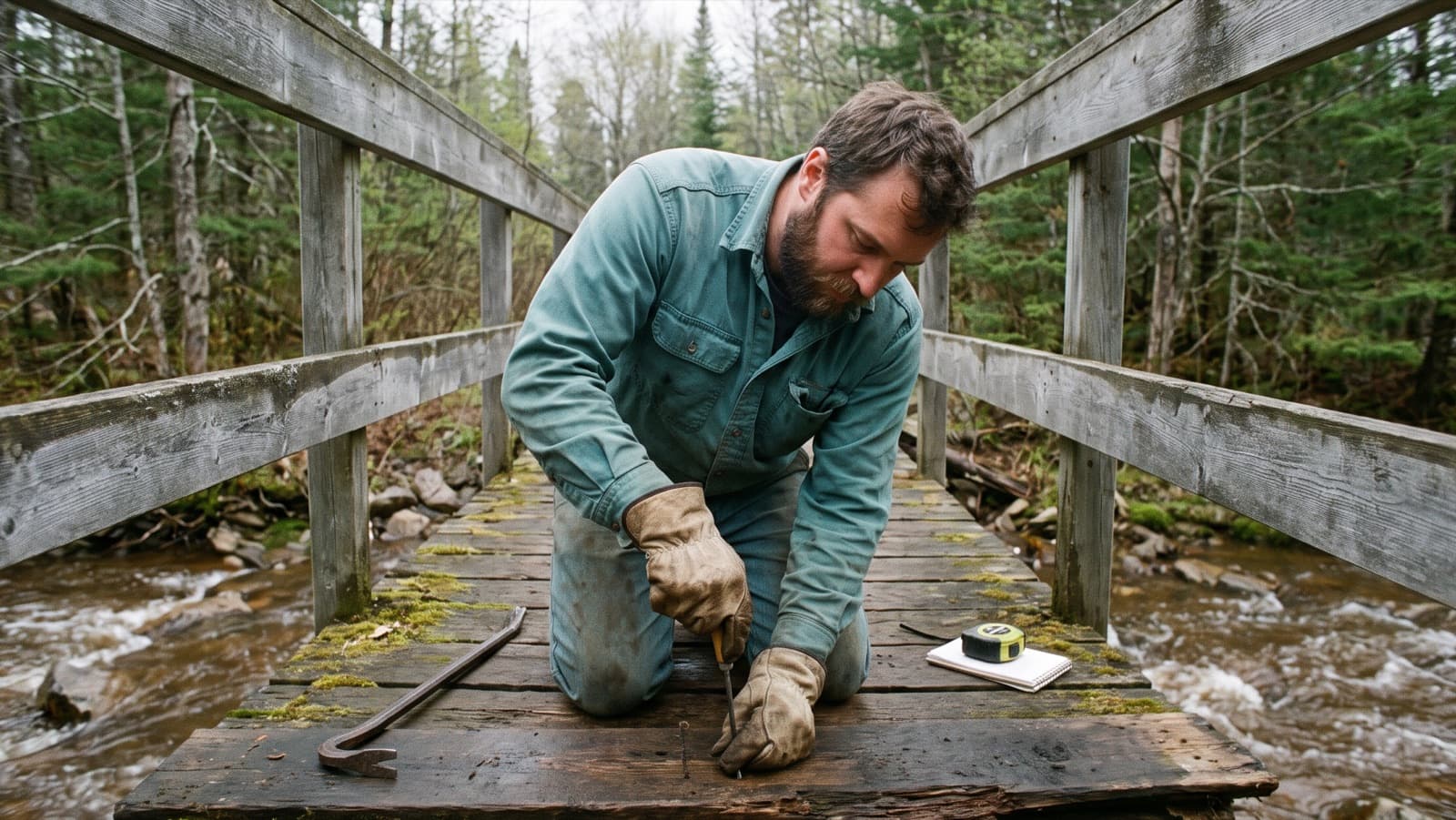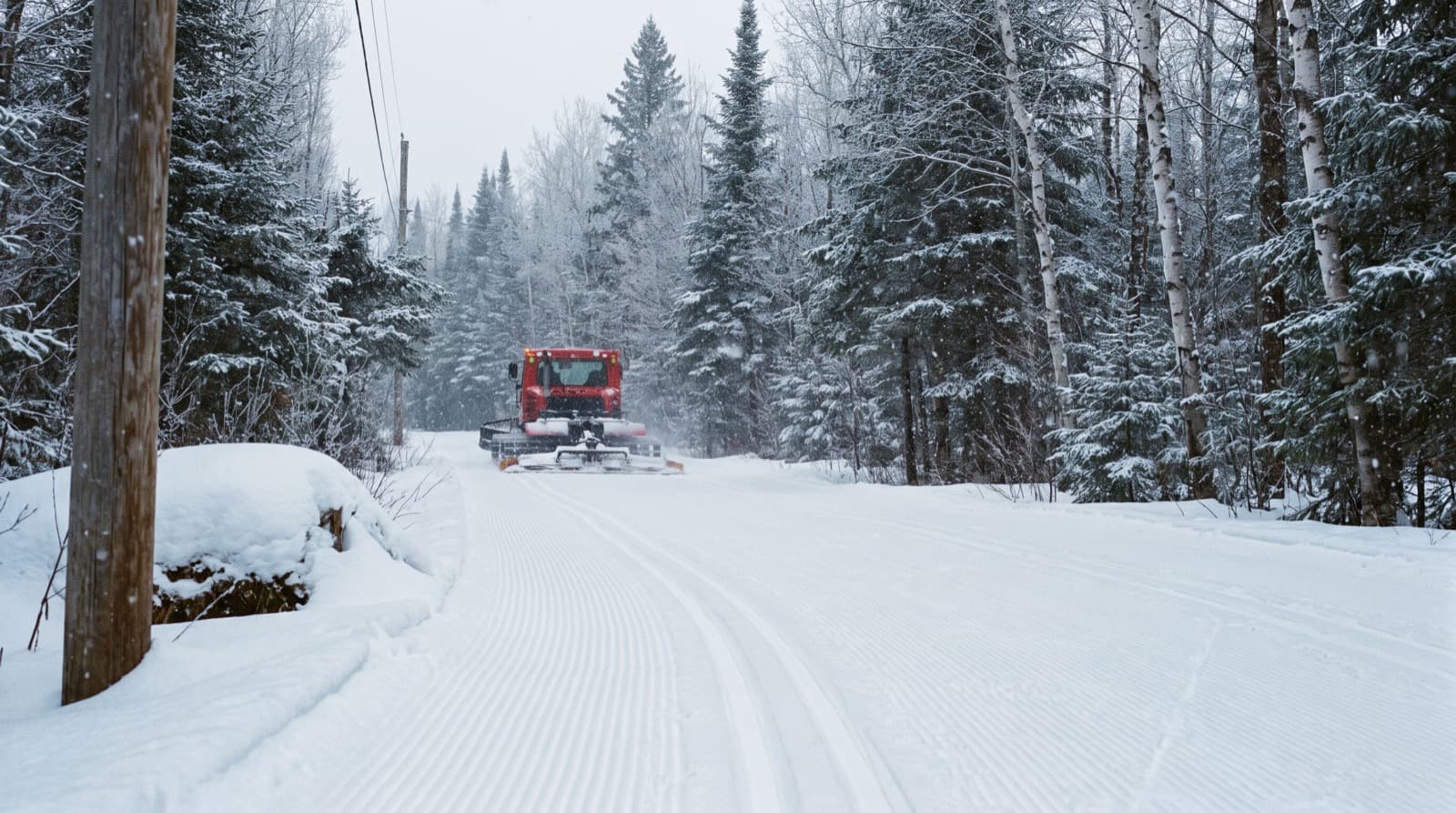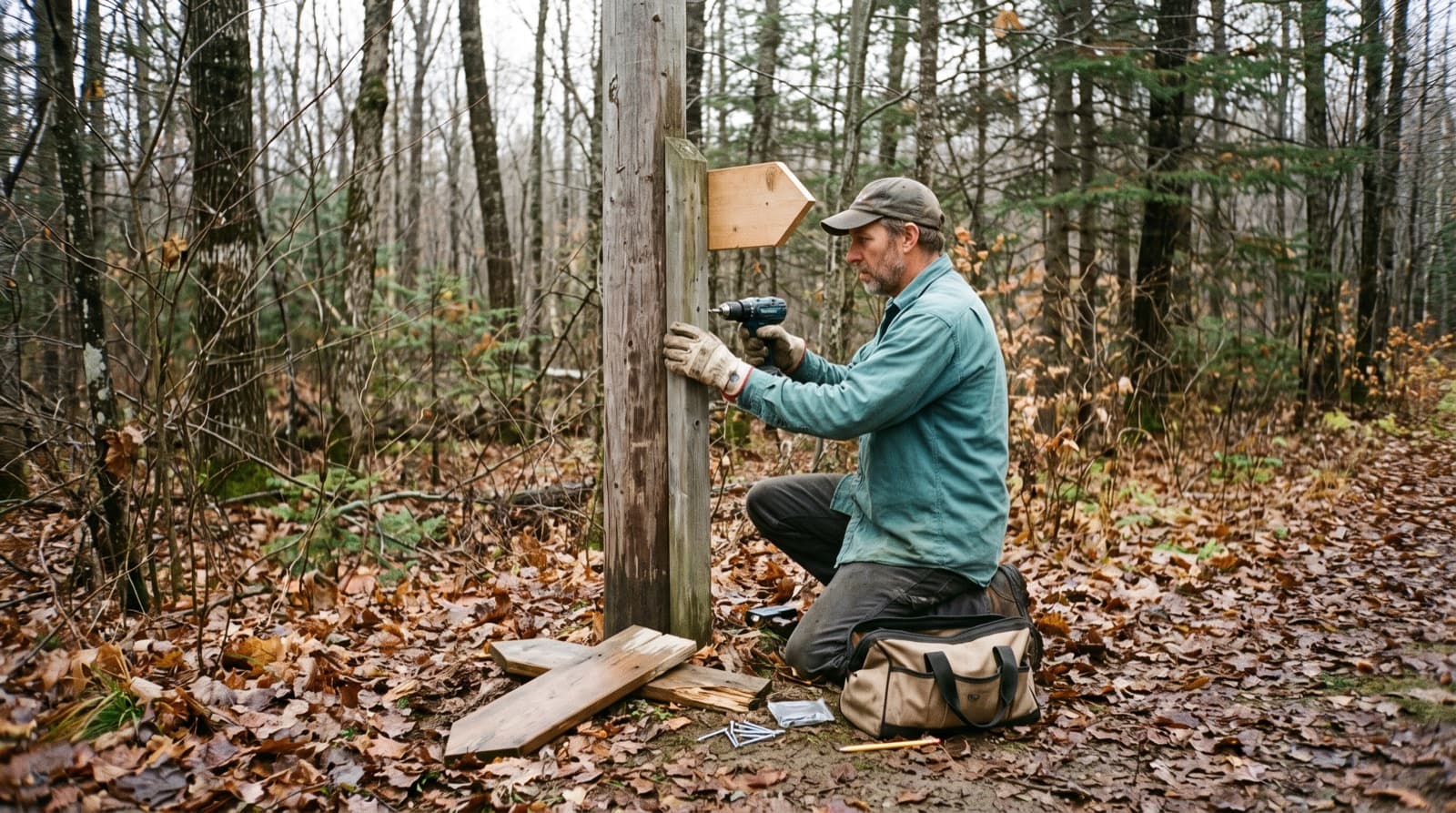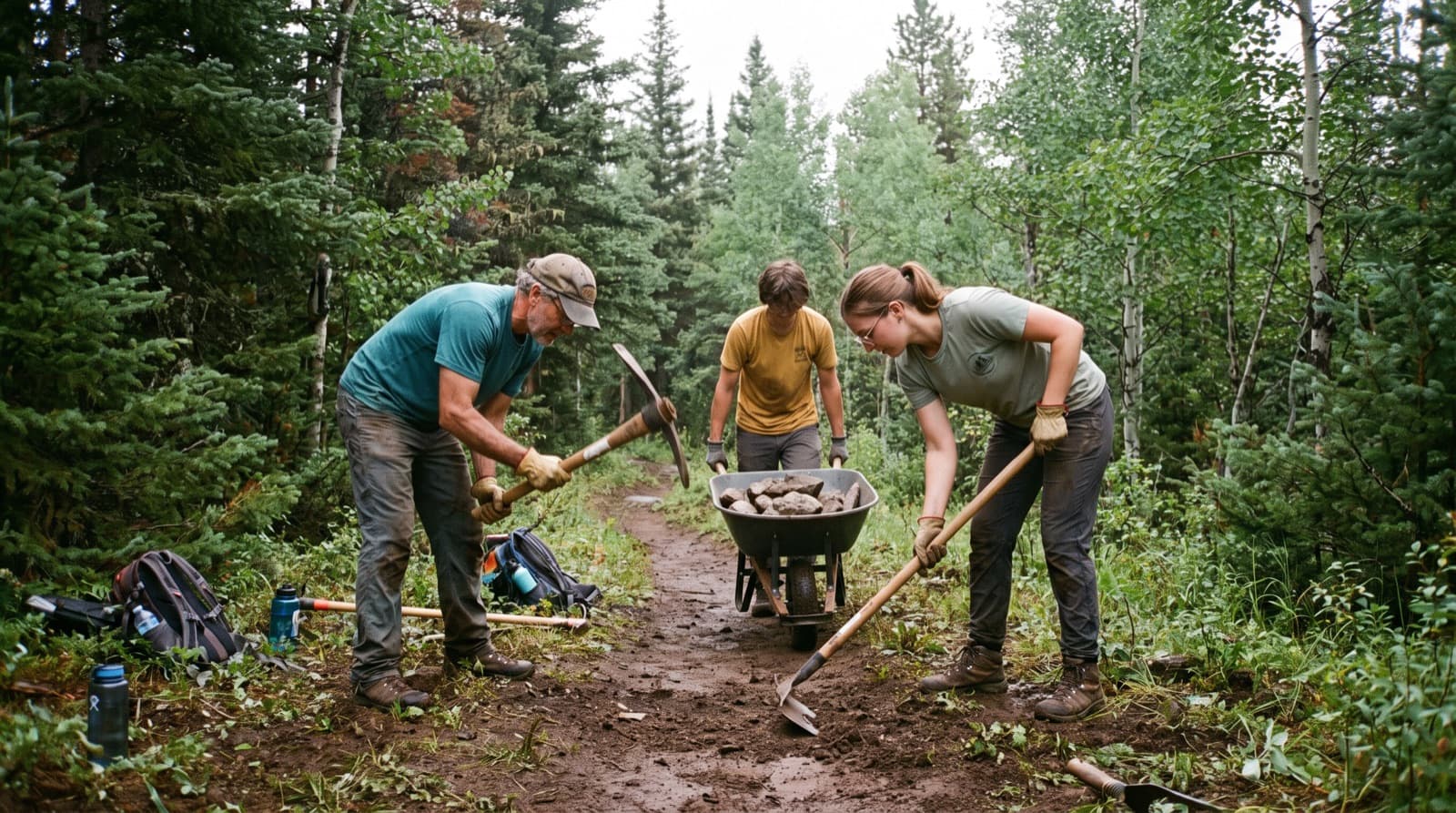
In 2012, the US Forest Service managed 158,000 miles of trail. About a quarter of them met the agency's own maintenance standards, according to a Government Accountability Office report. A Rails-to-Trails Conservancy survey found that 60% of rail-trails had no maintenance plan (RTC, 2015). In Québec, Rando Québec points out that networks are often run by nonprofits or volunteers with limited maintenance budgets (Rando Québec, 2022, in French).
In other words, trail management almost always happens with fewer people and less money than the job calls for. This guide collects what the agencies and federations that have written manuals on the subject recommend, scaled down to a club, an outdoor center or a municipality. Sources are listed at the end.
Describe each trail
The US Forest Service describes every trail it manages through five "Trail Fundamentals": Trail Type, Trail Class, Managed Use, Designed Use and Design Parameters (USFS). Trail Classes run from 1, minimally developed, to 5, fully developed. Designed Use is the most demanding of the uses the trail is managed for (USFS definitions).
You don't need the vocabulary. The idea works for any network: for each trail, write down who it's for, what use it was designed for, and how developed it's meant to be. That's what lets you say a narrow technical singletrack doesn't get the same maintenance standard as a family loop, and defend it in front of a board.
Design for water
The Québec hiking federation's guide says it plainly: water is the main natural cause of trail degradation (FQM, 2004, in French). The sustainable design rules published by IMBA Canada and the US Forest Service all aim at getting water off the trail:
- The half rule. A trail's grade shouldn't exceed half the grade of the sideslope it crosses (IMBA Canada). On a 6% sideslope, the trail stays at 3% or less (USFS).
- Moderate average grade. IMBA Canada recommends keeping the average under 10%, with grade reversals, and not exceeding 15% except on rock. The Forest Service notebook suggests 5 to 10% for high-use trails.
- Regular grade reversals. The Forest Service notebook places one roughly every 20 to 50 feet.
- Outslope the tread. The Appalachian Trail Conservancy and Suisse Rando give the same figure: 3 to 5% (ATC, Suisse Rando). California State Parks would rather restore outslope than keep cleaning plugged waterbars (California State Parks).
Two caveats are worth knowing. A National Park Service article notes that much of this guidance rests on field experience more than on measurement (NPS, Park Science). And on paved trails the picture changes: in the Rails-to-Trails Conservancy survey, managers named tree roots first (63%), then frost (44%) and water erosion (43%).
Inspect
The Forest Service has a full condition assessment method, TRACS. For a smaller network, field guides give simpler benchmarks:
- the Québec hiking federation recommends a first assessment as soon as the snow melts, a monthly visit ideally, and at minimum in spring, in summer once the leaves are out, after storms and after every complaint;
- Suisse Rando inspects sensitive sections every year, preferably in spring, and the others at least every three years, and asks for a written log even when nothing is found;
- the New York-New Jersey Trail Conference asks its supervisors to inspect all their trails once a year.
A tip from the Pisgah Conservancy in North Carolina: hike the trail in the rain to see where the water actually goes.
For each problem, the Québec guide records the location, the problem, the labour and materials needed, the estimated time and the urgency. That's what turns an inspection into a work list.
Decide what to fix first
We didn't find any guide that gives one universal order. They all put safety first. Fairfax County's trail management guide in Virginia says safety problems should always take precedence (Fairfax County), and asks for drainage problems to be repaired as soon as possible. In Switzerland, when there's a hazard, you put up a sign first, then a barrier, then close the section.
After that, everyone has their own levels. The Québec hiking federation used "priority, necessary, not urgent". Vélo Québec's inspection log uses "urgent, priority, secondary". The Pisgah Conservancy adds a useful rule for when hands are short: fix the trails that are degrading but still salvageable before the ones that are already lost.
Routine maintenance, season by season
The Appalachian Trail Conservancy gives its volunteers a simple calendar for their section (ATC):
- early spring: open the drains and check for blowdowns;
- summer: one or two trips to brush and remove berms;
- fall: clear leaves out of the drains.
For brushing, the Prescott National Forest adopt-a-trail program in Arizona aims for a corridor 8 to 10 feet high and 6 to 8 feet wide, with a simple test: walk down the middle of the trail with your arms outstretched (USFS Prescott). California adjusts the frequency to the vegetation, from twice a year to once every five years, and budgets structure replacement by dividing replacement cost by life expectancy.
Organize the people
Most networks run on volunteers, and the organizations with many of them have written down how they do it. The Appalachian Trail Conservancy typically gives each maintainer about a mile of trail. In France, the national hiking federation had about 8,000 volunteer trail markers for 180,000 km of routes in 2018 (FFRandonnée, in French). On safety, chainsaws are never run alone under the rules of the National Park Service and the Pennsylvania Parks & Forests Foundation.
We've put team structure in a separate article: How to structure a trail maintenance team that scales.
Fund the work, and count the hours
Volunteer hours aren't worth the same everywhere, and it pays to check before you fill out an application:
- in the US, the Recreational Trails Program accepts donated volunteer labor toward the non-federal share of a project (FHWA);
- in Manitoba, Trails Manitoba asks for hours to be converted into a reasonable dollar amount, and doesn't count hours worked before approval (Trails Manitoba);
- in Québec, the provincial trail funding program (PAFSSPA) excluded in-kind contributions, volunteer work included, from eligible costs (rules 2023-2024, in French), and the program page says it no longer accepts new applications;
- Trans Canada Trail's Trail Care Grant, up to $1,500, requires no matching funds (Trans Canada Trail).
Even where hours don't count as a contribution, they feed the annual report and the next application. Recording them on the day takes seconds; reconstructing them in November doesn't work.
Write a trail management plan
A trail management plan doesn't need to be long. Comparing the Appalachian Trail Conservancy's local management planning guide, Fairfax County's guide and Suisse Rando's maintenance concept, the same headings keep coming back:
- the area covered and the purpose of each trail;
- the inventory of trails and structures;
- sensitive sections;
- standards: design, signage, the level of maintenance you aim for;
- the inspection schedule, routine and after storms;
- who maintains what, and who pays;
- volunteer and partner management;
- emergency planning.
Fairfax County also keeps a multi-year renovation plan, updated every year from the inspections. It's a good habit: the plan stays alive, and the season that just ended prepares the next one.
In Sentinel
Sentinel puts these pieces on one map: trails and their structures with their inspections, geolocated tasks with photos and priorities, checklists for season opening, projects for larger work, hours logged by the crew, and trail conditions published on your website. The mobile app works offline. It's used by clubs, outdoor centers and parks in Canada, the United States and Europe.
Sources
- US Forest Service, Trail Management Basics, Trail Fundamentals Definitions, Trail Construction and Maintenance Notebook, TRACS, Adopt-A-Trail Manual (Prescott National Forest, 2019).
- Government Accountability Office, Forest Service Trails, GAO-13-618, 2013.
- IMBA Canada, Designing and Building Sustainable Trails, 2018.
- Appalachian Trail Conservancy, Trail Alignment & Issues with Water, Section Maintainer, Local Management Planning Guide, 2023.
- Fédération québécoise de la marche, Aménagement, évaluation et entretien des sentiers pédestres au Québec, 2004 (in French).
- Suisse Rando and FEDRO, Construction et entretien des chemins de randonnée pédestre, guide no. 9, 2025 (in French).
- Vélo Québec, Journal d'inspection et méthodologie de l'entretien, 2025 (in French).
- Rails-to-Trails Conservancy, Maintenance Practices and Costs of Rail-Trails, 2015.
- California State Parks, Trails Handbook, chapter 23, 2019.
- Fairfax County Park Authority, Guide to Trail Management.
- National Park Service, Park Science, vol. 33, 2017.
- New York-New Jersey Trail Conference, Best Practices; Pisgah Conservancy, Trail Assessment.
- FHWA, RTP Federal Share and Matching Requirements; Trails Manitoba, FAQ; Trans Canada Trail, Trail Care Grant, 2024; Gouvernement du Québec, PAFSSPA (in French).
- Rando Québec, news item, May 25, 2022; FFRandonnée, Qui balise les sentiers ?, 2018 (both in French).