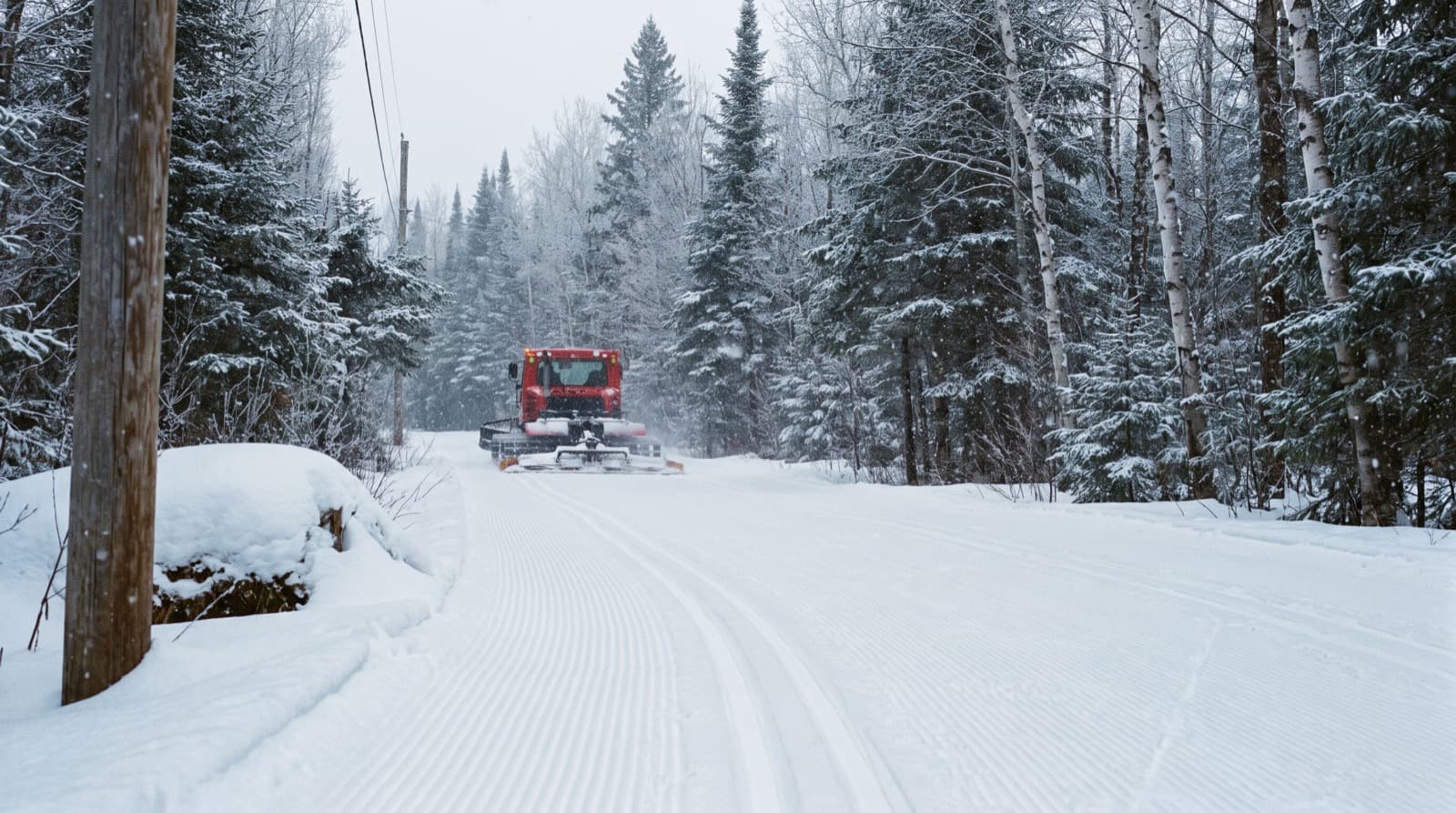
Nobody learns to groom from a blog post. You learn it in the cab, next to someone who knows your snow. What you can do from a desk is read what the organizations that have been grooming for decades have written down, and their rules overlap more than you might expect. This guide pulls together what those manuals say about cross-country ski, fat bike, snowshoe and snowmobile trails, then looks at how real nordic centers and clubs publish their grooming reports.
Sources are listed at the end. Where they disagree, we say so.
Let the snow set up
A groomer breaks snow grains apart and packs them. Over the following hours, those grains bond to each other and the surface hardens. Every manual we read stresses this, and it's what decides when you groom.
The groomer operator training guide from the American Council of Snowmobile Associations (ACSA) gives a set-up time of two to six hours, sometimes more than ten, and preferably overnight. Cross Country Canada's course preparation manual says two hours is the usual minimum, and as little as one hour when the snow is humid.
That's the case for grooming at night: it's colder, and nobody is on the trail. For fat bike trails, Vélo Québec recommends grooming as close as possible to the coldest time of the night. At Mount Washington in British Columbia, the nordic snowcat heads out around 11 p.m. and is off the trails by 9 a.m.
Temperature
The ideal ranges vary from one manual to the next, but not by much:
- Cross Country Canada: between −10 and 0 °C;
- ACSA (snowmobile trails): roughly +5 to +25 °F, about −15 to −4 °C;
- the National Capital Commission (NCC), for Gatineau Park: between −1 and −15 °C (NCC).
At the cold end, Cross Country Canada notes that extremely cold, dry snow, below −20 °C, doesn't pack well. ACSA adds a nuance: you can still get well-bonded snow in very cold weather, it just needs more time.
The warm end is the treacherous one. Wet snow that gets compacted and then freezes turns into what Cross Country Canada calls a "bullet proof" surface, with dangerously icy ruts. During a thaw, Vélo Québec's advice for fat bike trails is simply to close them.
During the storm or after?
Grooming in the middle of a snowfall often looks like you never groomed at all. The NCC notes that 5 cm tracks can fill in within two hours of heavy snow or wind (NCC FAQ). Most crews wait for the snow to stop.
Early season is the exception. To build a base, Cross Country Canada recommends packing ideally with every six inches (15 cm) of new snow, and ACSA advises against compacting a layer deeper than that. Vélo Québec presents both approaches, grooming as the snow falls or waiting for it to stop, and leaves the choice to each club's equipment and volunteers.
By activity
Cross-country skiing
The core tool is the tiller. Cross Country Canada calls it the most efficient implement for aging snow, with a warning: over-tilling leaves "dead" snow that won't hold. Then come rollers or compaction pans, and the track setter.
A few numbers:
- classic tracks are 17 to 30 cm apart and 2 to 5 cm deep under the standards Cross Country Canada uses; the Québec government's cross-country ski trail guide aims for 5 cm;
- set tracks within about two hours of grooming, while the snow is still workable;
- the NCC doesn't set classic tracks on grades steeper than 10%, and lengthens the untracked stretch when it's icy.
Fat bike
Vélo Québec's fat bike trail document advises against grades over 10%. It also flags the limit of small implements towed by a snowmobile: past 10 to 15 cm of accumulation, they struggle.
For riders, the most common rule is about ruts. IMBA Canada asks riders to stay off if their tire leaves a rut deeper than one inch, on tires wider than 3.5 inches that often run below 10 psi. Vélo Québec uses the same threshold, 2.5 cm. Some clubs are stricter: CAMBr asks for about half an inch. Pick your threshold and publish it. People follow a rule they know better than a vague "please be reasonable".
Snowshoeing
We didn't find a technical standard for packing snowshoe trails. A New Brunswick club, River Valley Cycling, found that five or six passes on snowshoes are enough to pack a 15 cm snowfall. The rule that comes up everywhere is about sharing: snowshoers walking in ski tracks destroy them, which is why most centers keep separate trails.
Snowmobile
Moguls form wherever sleds accelerate or brake hard: curves, stop signs, bridges, steep hills. That's ACSA's observation, and the guide adds two practical rules:
- pull the drag at about 5 to 7 mph (8 to 11 km/h); too slow and it won't roll the snow, too fast and it bounces;
- cut moguls at the bottom of the dips, or they come back.
The Minnesota DNR grooming manual recommends grooming at night or on weekdays. It also requires a log for every run: operator name, date, miles, hours, trail and segment.
Safety
Québec's 2017 guide asks for grooming outside opening hours, a sign announcing the machine on the trails, and closing trails after freezing rain until they've been reworked. Vélo Québec adds a white rear light for night grooming.
The grooming report
Grooming doesn't help much if nobody knows it happened. Looking at what real centers publish, reports fall into two groups.
The first gives one update time for the whole network. The NCC conditions page shows when it was last updated, the snow temperature, recommended wax, 24-hour snowfall and the share of trails open, with separate tables for classic and skate. Mount Washington publishes a single timestamp for its ski, snowshoe and fat bike lists.
The second gives the grooming time trail by trail. The fat bike report from Methow Cycle & Sport in Washington State lists each trail with a date, AM or PM, and a comment like "icy spots on corners". Ontario Parks has a "last groomed" column for its snowshoe trails. On the snowmobile side, the FCMQ's iMotoneige app in Québec shows the date each trail was last groomed and where the groomers are right now, from their GPS.
The second group answers the visitor's question better. "Groomed" without a time doesn't tell you much: by 10 a.m., a trail groomed at 4 a.m. and one groomed at noon the day before are not the same trail.
So a useful report gives, for each trail:
- access: open, closed, or open with work in progress;
- when it was last groomed, with the time;
- the surface, in a short vocabulary that never changes;
- for cross-country, what was set: classic, skate or both;
- anything that changes the plan: a fallen tree, open water, thin cover.
Ideally, the person who just groomed updates it as they go, rather than someone at the office the next morning.
In Sentinel
Trail conditions in Sentinel keep access (Open, Under construction, Closed) separate from the surface state. For cross-country skiing, the suggested list is Groomed, Powder, Hard pack, Icy, Soft, Thin cover; for snowmobile, Groomed, Bumpy, Icy, Thin cover. You can change it (Trail states).
The groomer updates the state from their phone, one trail at a time or a whole sector at once. On your website, each trail shows its state with how long ago it was set, for example "Groomed · 2 hours ago", and the board refreshes about every minute (Trail conditions: telling the public what's open). If you keep a grooming log like the Minnesota DNR's, each run can be a task on the trail, with the time logged against it.
Sources
- American Council of Snowmobile Associations, Guidelines for Snowmobile Trail Groomer Operator Training, 2005.
- Cross Country Canada, Course Preparation & Tracksetting, officials' manual.
- Minnesota DNR, Snowmobile Trails Assistance Program Maintenance and Grooming Manual, revised 2013.
- Gouvernement du Québec, Ski de fond : guide d'aménagement, d'entretien et de signalisation, 2017 (in French).
- Vélo Québec, Planifier et entretenir des sentiers de fatbike au Québec, 2020, and Guide de la pratique responsable du fatbike (in French).
- IMBA Canada, Fat Bike Best Practices, 2018.
- National Capital Commission, cross-country ski trail maintenance FAQ and The Art of Maintaining Gatineau Park's Ski Trails.
- Report examples: NCC, Mount Washington, Ontario Parks, Methow Cycle & Sport, FCMQ iMotoneige.
- Clubs: CAMBr, River Valley Cycling.