In the first quarter of fiscal year 2026, the US Forest Service put the deferred maintenance on its trails at $304.6 million, and on its trail bridges at $77.2 million (USFS, 2026). In Québec, the hiking federation Rando Québec notes that most grants for hiking networks only apply to building new infrastructure, not to routine maintenance or repair, even though many networks were built decades ago by volunteers (Rando Québec, 2020, in French). On the mountain bike side, IMBA's trail development guide, translated by Vélo Québec, cites a common planning rule: set aside 3 to 10% of the initial construction budget every year for professional maintenance of a natural-surface network, and 10 to 20% for bike parks and specialized trails (Vélo Québec, 2024, in French).
This guide is about the work itself: brushing, clearing fallen trees, keeping water off the trail, repairing the tread, and choosing the tools and the right time. For inventory, inspections, priorities and planning, see our trail management guide. Sources are listed at the end. Where they disagree, we say so.
Brushing the corridor
Rando Québec says it up front: there is no universal standard for the width to clear. For a hiking trail, the main sources give:
- Rando Québec: a clearing area 2 m wide and 2.5 m high above the walking surface (about 6.5 by 8 ft), sometimes more depending on winter conditions;
- the Appalachian Trail Conservancy: 4 ft wide by 8 ft high (ATC);
- the US Forest Service maintenance notebook, as an example from the Northern Rockies: 2 m (6 ft) wide by 2.5 m (8 ft) high, and 2.5 m (8 ft) by 3 m (10 ft) for pack stock (USFS).
Other uses need more room. The Forest Service design parameters go up to 72 to 96 inches wide for bikes on the most developed trail classes, and up to 10 to 22 ft wide and 8 to 12 ft high, above the normal maximum snow level, for snowmobiles (USFS). For cross-country skiing, the Québec education ministry's trail guide calls for a vertical clearance of at least 2.5 m above the snow-covered trail, allowing for snow buildup on the ground and branches weighed down by snow and freezing rain (Gouvernement du Québec, 2017, in French).
To decide what to cut, Rando Québec suggests the "door frame" technique: walk the trail imagining you are holding a frame 2.5 m high and as wide as the clearing you want, and remove everything that enters it. Before starting, identify hazard trees and remove snags and hung-up trees that could fall into the walking area.
On cutting, the manuals complement each other:
- cut stems at the base of the plant, not in midair at the clearing limit, and scatter the debris as far as practical (Forest Service);
- saw a large branch in three cuts, the last one at the collar near the trunk, and leave no brush piles more than a meter high (Rando Québec);
- on a brush cutter, use a three-tooth blade for stems smaller than your little finger, and a 24-tooth "maxi" blade for anything bigger (Rando Québec).
They differ on when to cut a tree down rather than prune it: for Rando Québec, when more than 30% of its branches would need pruning; for the Forest Service, usually when more than half the tree does.
When time or money is short, the Forest Service suggests brushing only the uphill side of the trail. On frequency, the notebook notes that some trails may have to be brushed several times a year, others once every few years. Suisse Rando gives a rough cost: 5 to 10 Swiss francs per meter for brushing and minor repairs, at 2024 prices (Suisse Rando, in French).
Fallen trees
Rando Québec leaves it to each manager to set how often trees are checked, but recommends, by trail class:
- for easy walking trails (sentiers de promenade) and universal-access trails: a seasonal visit and maintenance, a check after extreme weather, and immediate action when a hazard tree is reported;
- for developed and lightly developed rustic trails: a yearly visit of the network, a check within a reasonable time after extreme weather or a hazard tree report, then action as soon as possible, or within a reasonable time depending on the risk and how busy the trail is;
- for undeveloped trails: a schedule spread over several years, for example every five years.
The same guide reports the only case that, to its knowledge, set a precedent: a branch had fallen on a hiker, seriously injuring them. The judge relied on two arguments. It was impossible to assess every tree, so the risk was inherent to the activity. And the trail manager had shown due diligence by assessing the condition of its trails every year and archiving the field visit reports.
Storms are expensive. A study of Québec's Sentier national, carried out by TouriScope for Rando Québec, reports that the International Appalachian Trail's Québec chapter (SIA Québec) spent more than C$30,000 over two years clearing its trail after high winds (TouriScope, 2024, in French).
To clear a log, the Forest Service says to cut it out as wide as your normal clearing limits on the uphill side, closer to the trail on the downhill side, then roll the pieces off the trail and outside the clearing limits on the downhill side, never leaving them across ditches or waterbar outflows. Rando Québec instead recommends cutting beyond the clearing area rather than bucking out only the width of the walking area. The Forest Service leaves leaners, trees leaning across the trail, to highly qualified sawyers. Rando Québec counts clearing small trees under 15 cm (6 in) as light work, and felling a hazard tree as heavy work for qualified personnel, paid or not.
Chainsaws: training and gear
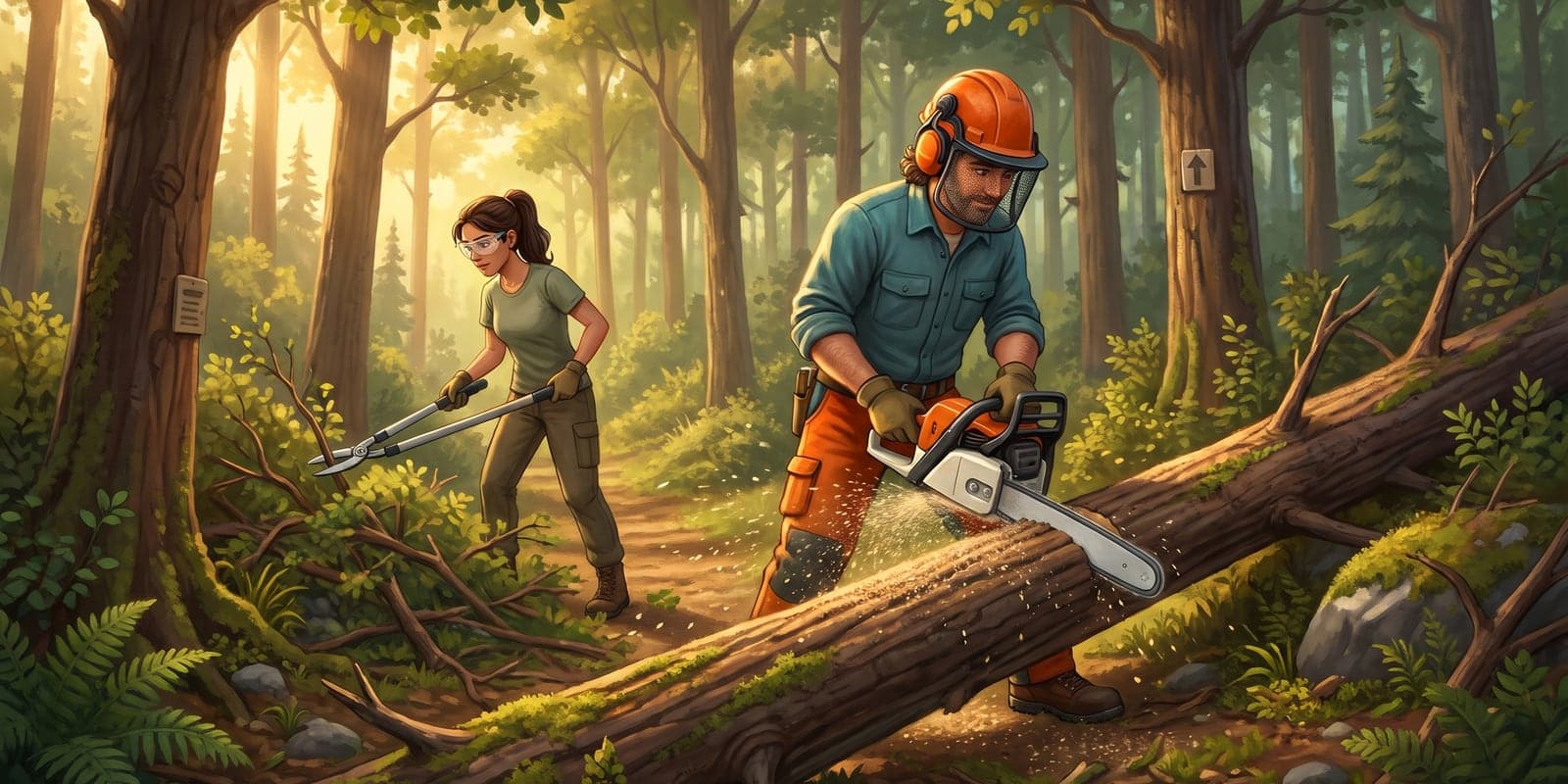
According to IMBA's guide, as translated by Vélo Québec, volunteers are rarely allowed to run a chainsaw, and only people who have passed a chainsaw certification course and wear the right protective equipment (eye and ear protection, chaps, gloves and reinforced footwear) should use one.
In the United States, on National Forest System lands, the policy revised in 2023 requires (USFS, FSM 2358):
- a National Sawyer Certification Card, valid for three years, and current first aid and CPR certification;
- a minimum age of 18 for chainsaws and 16 for crosscut saws;
- three sawyer levels, from A, for the least complex situations under the immediate supervision of a B or C sawyer, to C, for complex situations;
- for chainsaws: a hard hat, safety glasses or a mesh face shield, gloves, long sleeves, laced boots, hearing protection for gasoline-powered saws, and chaps that overlap the boots by at least 2 inches, or cut-resistant pants.
In Québec, the health and safety regulation for forest management work (Règlement sur la santé et la sécurité dans les travaux d'aménagement forestier) requires a worker felling a tree with a chainsaw to be at least 16, to have taken the "Santé et sécurité en abattage manuel" training and to hold the corresponding certificate. It also sets a minimum of 45 m (about 150 ft) between two fellers (LégisQuébec, in French). It covers forest management work and workers as defined by Québec's occupational health and safety act, meaning people working for an employer under a contract of employment, even without pay. It says nothing about volunteers.
On working alone, the rules differ. The Forest Service allows it in limited situations, such as removing a tree blocking a road, with two-way communication set up before starting. The Québec regulation allows it if a safe and effective monitoring method is in place. In France, a Ministry of Agriculture fact sheet on harvesting storm-felled timber states that on those sites, a logger is not allowed to work alone (Ministère de l'Agriculture, 2018, in French).
Keeping water off the trail
The Forest Service notebook sums it up: the number one enemy of simple drains is sediment. When sediment fills the drain, water tops the waterbar and keeps running down the tread (USFS).
The angle matters, and the sources don't agree on it:
- the Forest Service: 45 to 60 degrees to the trail; below 45 degrees, waterbars are prone to clogging on 15 to 20% grades, and above 20% they are mostly useless;
- Rando Québec, for a log waterbar: 30 to 45 degrees depending on the slope, with no point going beyond 50 degrees;
- Suisse Rando, for log or stone cross drains: at least 30 to 45 degrees, a slope of about 5%, and extending at least 20 cm (8 in) past the path; below 30 degrees, the guide expects open-top cross drains to clog often. For dug drains backed by an earth or gravel mound, about 45 to 60 degrees;
- the Québec hiking federation (FQM, now Rando Québec), in 2004: about 30 degrees (FQM, in French).
For existing trails with water problems, the notebook prefers rolling grade dips or knicks to waterbars, and says the best fix for a waterbar that turns water too abruptly is to rebuild it as a rolling or armored grade dip. A study published in 2017 in the Journal of Environmental Management recalls an older survey (Marion, 1994) of 528 km (328 miles) of trail in Great Smoky Mountains National Park: 44% of waterbars were judged very effective there, compared with 20% of drainage dips, which were earthen and unarmored. The authors conclude that both are ineffective unless properly installed and frequently maintained, and full-tread grade reversals work better than either (Marion and Wimpey, 2017).
At the two sites where they measured drain spacing, the authors found drains too far apart. The Forest Service's 1991 guidance, for example, calls for a drain every 23 m (75 ft) on grades of 7.1 to 9% in medium-textured soils. At sample points on native soil steeper than 7%, spacing exceeded the guidance at 72% of the points in Hoosier National Forest, Indiana, and at 96% in Big South Fork National River and Recreation Area, Tennessee and Kentucky.
To clean a drain:
- dig below the sediment down to mineral soil, or it will fill back in quickly (Georgia Appalachian Trail Club);
- don't settle for a swipe of the shovel or a kick through the berm: those small openings soon plug (Forest Service);
- at the inlet of a culvert, dig a settling basin at least 300 mm (1 ft) deeper than the base of the pipe, where sediment is much easier to shovel out than from inside the culvert (USFS). Suisse Rando also recommends sediment traps upstream of pipes.
How often? The Roanoke Appalachian Trail Club asks its maintainers to clean waterbars twice a year, in spring and fall (RATC). California State Parks finds that a single spring cleaning is not enough: waterbars need cleaning and monitoring throughout the wet season, especially during peak storm events. Peak flows are also the best time of year for the work, since flowing water then helps flush sediment and debris through structures (California State Parks, chapter 26). On bike trails, IMBA's guide as translated by Vélo Québec describes drain clearing as raking out the soil that builds up in the drainage basins at every grade reversal.
Repairing the tread
According to the Forest Service notebook, loss of outslope is the first maintenance problem that develops on all trails. If you can do nothing else when budgets are tight, reestablish the outslope. The notebook calls for at least 5% outslope, a little more than the 3 to 5% from the Appalachian Trail Conservancy and Suisse Rando cited in our management guide (USFS).
The same notebook names the main culprit: berm formation is the single largest contributor to tread erosion, and removing berms is always the best practice. Slough from the backslope that doesn't get removed is the main reason trails creep downhill over time. A few other rules from the notebook:
- remove roots that run parallel to the tread, which funnel water and are slippery;
- when removing a rock, take it out to at least 100 mm (4 in) below the tread surface;
- don't let the trail widen: traffic going around puddles widens the trail, and eventually the puddle. The FQM made the same observation.
California State Parks adds a limit: no root over 3 inches in diameter should be removed without consulting a resource specialist (California State Parks, chapter 25). It puts "trio maintenance", meaning brushing, slough and berm removal and reshaping the tread, on a usual two- to seven-year cycle, depending on how fast the trail degrades. Fill in low areas is compacted in lifts of 3 inches at most, in soil moist enough that a squeezed handful stays in a clump without water coming out. Suisse Rando puts tread restoration at 10 to 25 Swiss francs per meter.
For a mud pit, the Green Mountain Club in Vermont gives an order: first keep water from reaching it, then drain it, often by removing the berm, and only then relocate the trail or harden it with rock work or puncheon. Logs, bark or brush that hikers add for a drier stepping surface eventually decompose and act like a sponge, making the mud worse. The club also asks hikers to look for a berm they can kick out to drain the pit, while the Forest Service calls that kind of kick useless (Green Mountain Club, 2026).
Hand tools
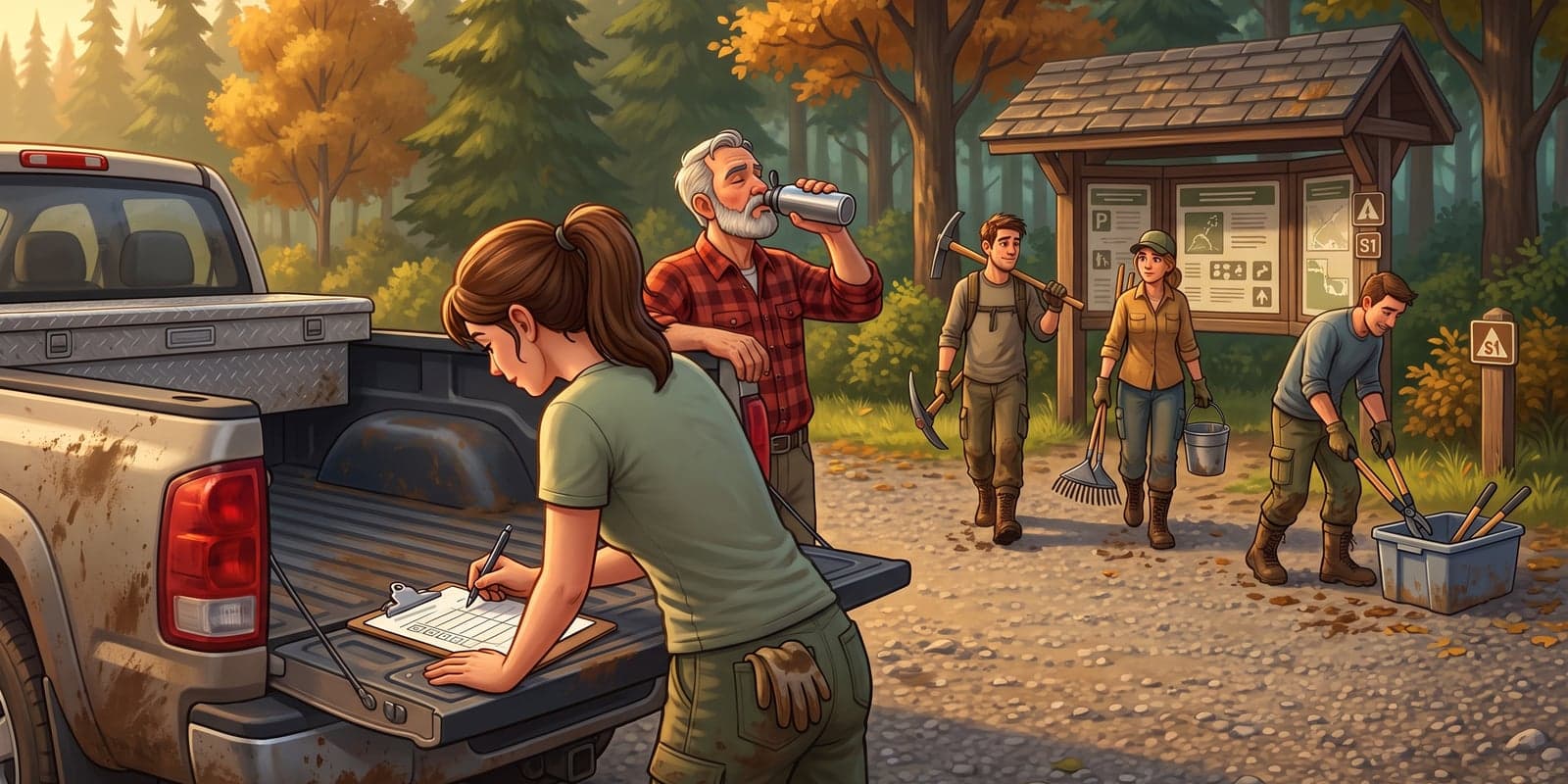
The US Forest Service has a whole manual on trail tools (USFS, 2005). Discussing the Pulaski, it notes that combination tools are less effective than single-purpose tools. Here are the main ones:
| Tool | What the sources say |
|---|---|
| Pick mattock | Often recommended as the standard tool for trail work. Two people with pick mattocks may not need to carry rock bars. |
| Pulaski | Popular mostly because it is widely available and easier to carry than several single-purpose tools, but an ax balances better and chops more safely, and grub hoes are more efficient. About 5½ lb, with a 36-inch handle. |
| McLeod | Works well in light soils and for reestablishing tread where material from the backslope has sloughed onto the trail; essential for compacting tread, helpful for checking outslope. Inefficient in rocky or unusually brushy areas. |
| Rock bar | For lifting or skidding heavy objects; a rounded end, if it has one, compacts material into rock cracks. |
| Loppers | Up to 3 inches with the heaviest models according to the Forest Service, no thicker than your thumb according to the ATC. |
The sources don't agree on everything. Vélo Québec's tool sheets (in French) call the Pulaski "the professionals' true pick," while both Forest Service manuals rank it behind single-purpose tools. IMBA Canada lists the shovel as rarely used; Vélo Québec finds it versatile and very useful. For light work on the tread and drainage, Rando Québec lists only loppers, a bow saw, a shovel and a rake.
On safety, the rules overlap (USFS):
- keep at least 3 m (10 ft) between people using chopping and cutting tools; the Washington Trails Association puts it differently, with others always outside the combined length of your arm and tool (WTA);
- carry tools in hand on your downhill side, blade forward and down, and throw the tool clear if you fall;
- at the work site, lay tools on the uphill side of the trail with the business end farthest uphill;
- wear a hard hat, gloves and safety glasses, and sheath blades for transport.
For power equipment with a rotating cutting head, such as a brush cutter, a Forest Service job hazard analysis in North Carolina requires at least 100 ft between workers (USFS).
Machines
For heavy work, the Forest Service notebook notes that mini excavators are more popular with trail contractors than dozers, because dozers can only push material, and suggests considering a motorized carrier if budget and regulations allow. An older Forest Service publication gives the decision rule: compare the cost of renting or buying the equipment with the cost of a hand crew, counting a small crew of at least three people to work with the machine (USFS, 1996).
IMBA Canada recommends tracked rather than wheeled machines and insists on an experienced trailbuilder at the controls, because an inexperienced operator can have a greater impact on the environment. It also describes a hybrid model where the machine does the heavy work and volunteers do the finishing (IMBA Canada). Suisse Rando lists the unnecessary use of large machines among cost drivers, and prices a small excavator at 175 Swiss francs per day.
In the United States, the Wilderness Act prohibits motorized equipment and any other form of mechanical transport in designated wilderness, except as necessary to meet minimum requirements for administering the area (16 U.S.C. § 1133). The ATC notes that crosscut saws are required there (ATC).
The right time, season by season
In spring. Suisse Rando recommends doing the yearly check of vulnerable sections at snowmelt. Spring is also when to hold back. In Vermont, mud season generally spans the six weeks between snowmelt and Memorial Day, at the end of May, and land managers may close trails (Vermont FPR). Vermont's Department of Forests, Parks and Recreation (FPR) gives riders its own benchmark: if your tires leave ruts more than half an inch deep, turn around and ride elsewhere (Vermont FPR, 2023). In the Adirondacks, the New York State Department of Environmental Conservation asks hikers to postpone hikes above 2,500 ft until trails have dried and hardened, and to walk through the mud down the center of the trail rather than around it (NYS DEC, 2022). In Québec, Vélo Québec's closure protocol lists freeze-thaw as a reason to close a trail, rules out a simple rope across it and calls for an inspection before reopening (Vélo Québec, in French).
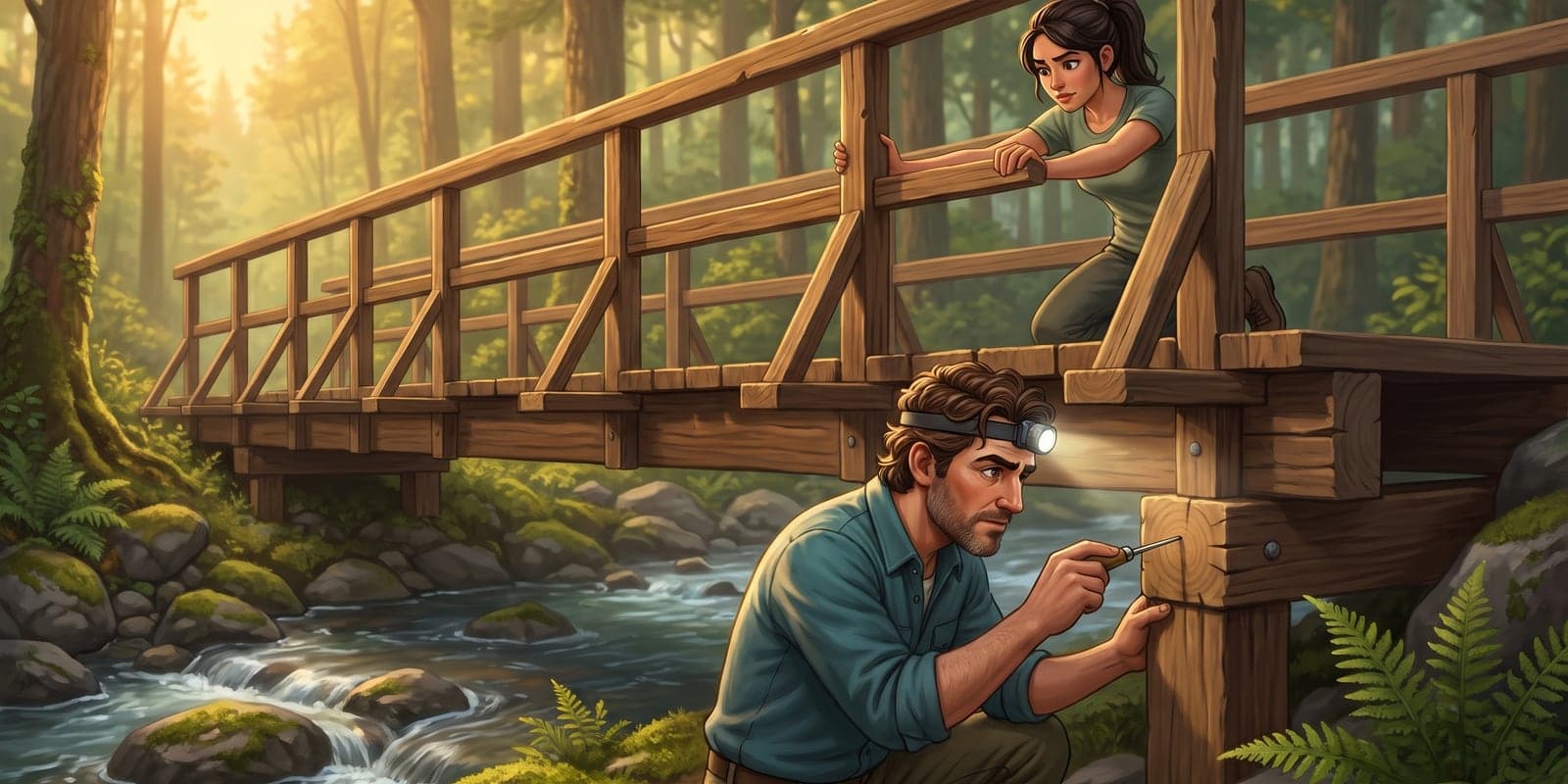
During the season. Vélo Québec's inspection log calls for checking everything before opening and after every major weather event. During the season, it sets debris clearing daily, fall zones weekly, and signage and wooden features monthly (Vélo Québec, in French). The busier the trail, the more often it should be inspected.
In fall. The FQM recommended regrading the tread when it shows signs of wear, or in the fall so it can settle over the winter. Suisse Rando, without tying it to a season, counts clearing soil and leaves off structures as routine maintenance, so wood doesn't rot and metal doesn't corrode early. Leaves on the trail are a debated topic: IMBA's guide as translated by Vélo Québec says they should generally be cleared off the tread, except during freeze-thaw, when they protect it.
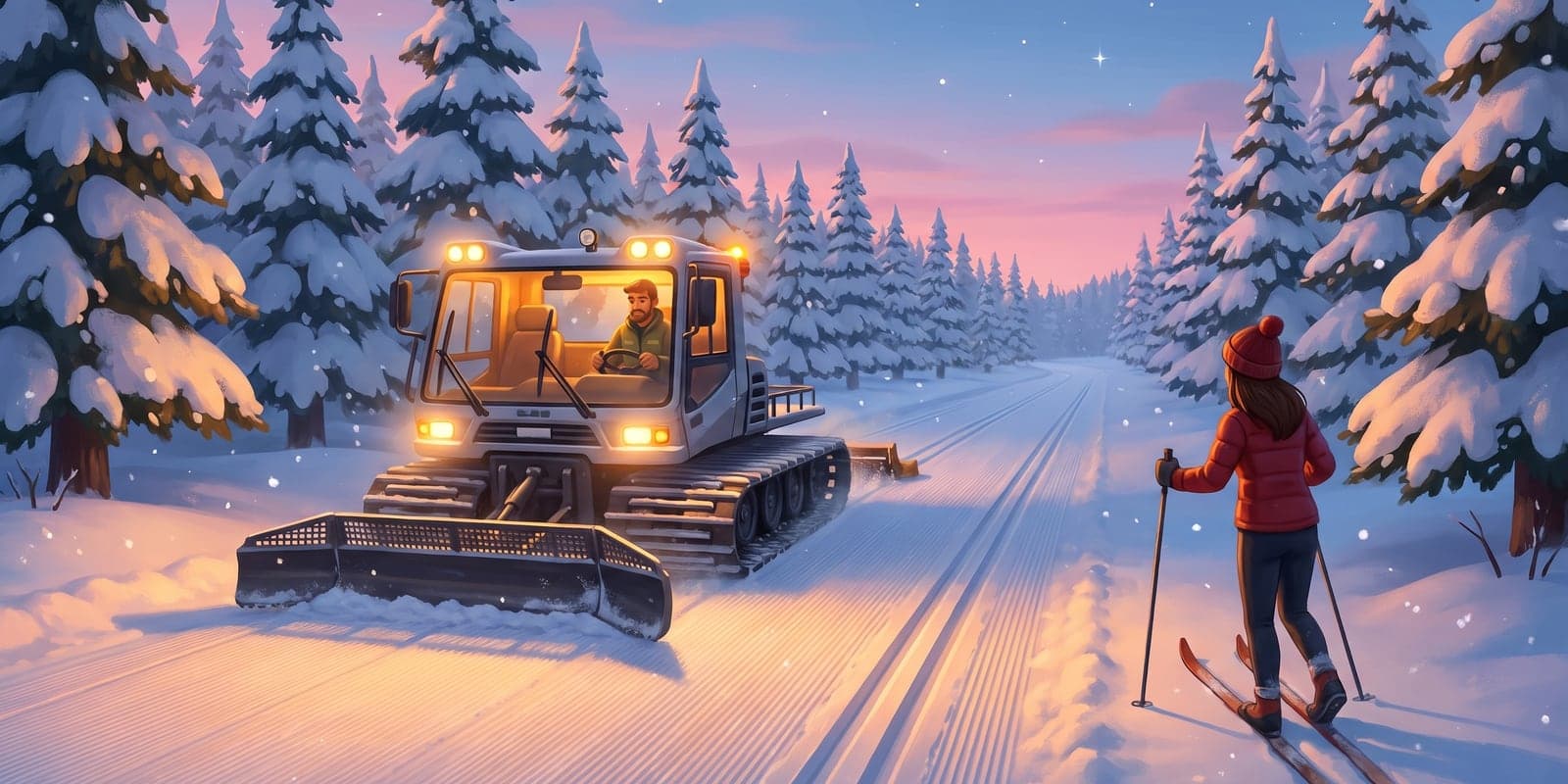
Before and during winter. Suisse Rando asks crews to reinforce or remove structures heavily exposed to snow before winter and, at high elevation, to take down removable bridges for the winter. On snowmobile trails, Minnesota's trail guidelines call for removing, shortly before the season, protruding rocks, logs and woody debris that would interfere with grooming and rider safety (Minnesota DNR, 2007). In Québec, after freezing rain or another major storm, a cross-country ski trail must stay closed until adequate mechanical maintenance of the ski surface has been done (Gouvernement du Québec, 2017, in French).
In Sentinel
In Sentinel, each problem found in the field becomes a geolocated task with a photo, and the built-in task types match the work in this guide: Fallen Tree, Drain, Water, Mud, Erosion (task types). Checklists cover season opening and closing inspections, and an item such as brushing can be measured as a percentage of the trail done, with the finished stretch shown on the map (how it works). Hours are logged on each task, and the mobile app works offline. Two video tutorials show this in the app: Create a task in the field and Checklists: the same checks, on every trail.
Sources
- US Forest Service, Trail Construction and Maintenance Notebook, 2007: corridor and trees, drainage, tread, culverts, tools and equipment.
- US Forest Service, Handtools for Trail Work, 2005; Trail Design Parameters; Mechanized Trail Equipment, 1996.
- US Forest Service, FSM 2358, Saw Program, 2023; Deferred Maintenance Needs, FY2026 Q1; job hazard analysis, National Forests in North Carolina, 2021.
- Rando Québec, Normes en aménagement de sentiers, 2020; TouriScope for Rando Québec, Étude du potentiel touristique de la randonnée pédestre sur le Sentier national au Québec, 2024 (both in French).
- Vélo Québec and IMBA, Guide d'aménagement des sentiers de vélo de montagne, 2024; Vélo Québec, Journal d'inspection et méthodologie de l'entretien, Protocole de fermeture des sentiers, 2025; Fiches outils, 2013 (all in French).
- Fédération québécoise de la marche, Aménagement, évaluation et entretien des sentiers pédestres au Québec, 2004 (in French).
- Québec Ministry of Education and Higher Education, Ski de fond : guide des principes d'aménagement, d'entretien et de signalisation des sentiers, 2017 (in French).
- Gouvernement du Québec, Règlement sur la santé et la sécurité dans les travaux d'aménagement forestier; Loi sur la santé et la sécurité du travail (both in French).
- Suisse Rando and FEDRO, Construction et entretien des chemins de randonnée pédestre, guide no. 9, 2025 (in French).
- French Ministry of Agriculture, Fiche réflexe 8: sécurité des intervenants, 2018 (in French).
- Appalachian Trail Conservancy, Brushing: Instructor Guide; Trail Tools: Brushing, 2020.
- Roanoke Appalachian Trail Club, Trail Maintainer Guidance, 2022; Georgia Appalachian Trail Club, Trail Maintainer Guide.
- J. L. Marion and J. Wimpey, Assessing the influence of sustainable trail design and maintenance on soil loss, Journal of Environmental Management, 2017.
- California State Parks, Trails Handbook, chapter 25 and chapter 26, 2019.
- Green Mountain Club, Managing Mud Pits and Puncheon on the Long Trail, 2026; Vermont FPR, Mud Season and press release, April 5, 2023; NYS DEC, muddy trail advisory for the Adirondacks, 2022.
- IMBA Canada, Tool Resource Guide and Mechanized Trailbuilding, 2018; Washington Trails Association, Trail Work Safety Guidelines.
- Minnesota DNR, Trail Planning, Design, and Development Guidelines, 2007; Wilderness Act, 16 U.S.C. § 1133.