On April 28, 1995, a viewing platform collapsed at Cave Creek, in New Zealand's Paparoa National Park. It fell about 30 m with 17 people on it, and 14 young people died (Department of Conservation). The Commission of Inquiry found that the platform had not been built in accordance with sound building practice, that no plans were followed, and that it had never been the subject of any formal inspection.
The commission also wrote something every trail manager should know: even if there had been inspections, it is unlikely the fundamental design and construction defects would have been revealed (Engineering New Zealand). Finding them would have meant taking much of the structure apart. So the lesson isn't "inspect and everything will be fine". It comes in three parts: a structure designed by someone qualified, inspected while it's being built, then followed by a system of regular inspections. Engineering New Zealand lists both inspection points among its lessons from the disaster.
This guide is about the third part, the one that falls to trail managers once a structure is in place. Sources are at the end.
What the large agencies do
The US Forest Service requires a certified trail bridge inspector to inspect all its trail bridges at least every five years (USFS, 2022). Its handbook adds that a more frequent interval may be appropriate depending on the bridge's complexity, age, condition and use (FSH 7709.56b). The inspection report is an official record, and each major bridge has a permanent file: as-built plans, inspection reports, load rating calculations where applicable, and a record of repairs.
New Zealand's post-Cave Creek regime is tighter. The Department of Conservation manages about 12,500 wooden structures. All of them are inspected every two years by a DOC asset inspector, and about 4,500 higher-risk structures are also inspected by a structural engineer every six years (Department of Conservation, 2024). To become an inspector, you inspect 100 structures alongside a qualified inspector, pass a written exam set by an engineer, then inspect 20 more with an engineer.
At the scale of a club or a trail center
Most networks have no certified inspector or engineer on staff. Field guides offer simpler schedules suited to lighter structures:
- the Squamish-Lillooet Regional District's risk management policy in British Columbia inspects high-use trails twice a year, and medium-use trails twice a year as well when they have technical trail features, "generally (but not always) a manmade structure" (SLRD);
- Vélo Québec's guide for summer camps asks for technical features to be inspected before each season and after a long period without use, for bolt tightness to be checked, and for any feature with rotten wood to be closed (Vélo Québec, 2013, in French);
- Vélo Québec's inspection log points out that bridges, boardwalks, lookouts and built features need regular checks, and classes "unstable or damaged construction" as urgent: the inspector secures or closes the area on the spot.
That last rule may be the most useful one. An inspection that finds a dangerous structure and only writes it down in a report hasn't protected anyone.
What to look for on a wooden structure
The Forest Service's quick reference guide for trail bridge inspection says it up front: detecting decay is a major component of a timber bridge inspection. The guide explains why decay hides. It needs oxygen, a temperature between roughly 32 and 90 °F, and wood with a moisture content above about 25%. That's why it often starts at the waterline, and why treated wood can rot from the inside once the preservative shell is breached, with no sign on the outside.
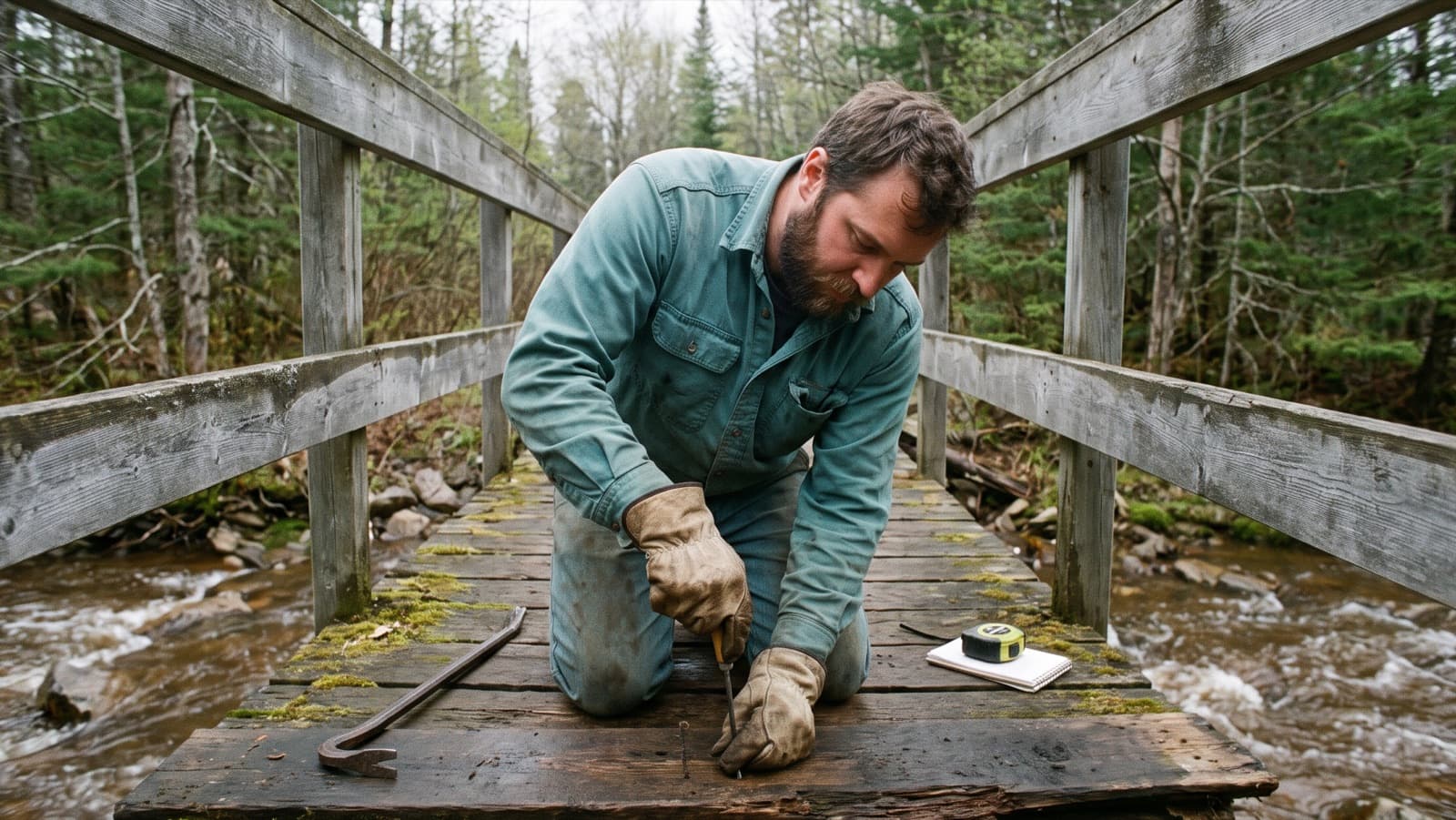
To find it, the Federal Highway Administration describes probing with an awl or pick hammer: sound wood splinters, decayed wood breaks off abruptly and feels too soft (FHWA). The FHWA adds two cautions: tell water-softened wood apart from decayed wood, and expect the method to be less reliable on soft species like western red cedar.
The second enemy is moving water. The Forest Service calls it scour: streambed or bank material carried away around the abutments. The Québec hiking federation's old guide put it simply: an exceptional or sudden flood can undermine the foundations of a footbridge or bridge (FQM, 2004, in French). The same guide said not to tolerate structures that are rotten, slippery or have nails sticking out, and to install a solid railing wherever there's a fall risk.
A good inspection finding is specific. The Forest Service guide's example: 50% of the 3½-inch deck shows ½ inch of surface rot, and five planks need to be replaced. Six months later, someone else will know exactly what that means.
Load: the blind spot
A visual inspection tells you what condition a structure is in. It doesn't tell you what it can carry. Vilas County, Wisconsin, owns 35 recreation bridges, 5 of them rated for 25,000 lb. In 2021, a county supervisor described a 22,000 lb groomer crossing a bridge rated for 20,000 lb (WXPR). The county decided to inspect half its bridges every year, at $200 a bridge, while noting that those inspections cover damage, not load capacity.
For a snowmobile or ATV club, the question is concrete: do you know the load rating of each of your bridges, and the weight of your machine?
When inspection does its job
Parks Canada published a more ordinary example, and a more typical one. The Attikamek Trail footbridges, built in 1995, were inspected in 2023. All the deck boards were in poor condition and due for replacement within a year; the railings, within two. The substructures were rated fair to good (Impact Assessment Agency of Canada). The work was scheduled for September and October 2024.
That's what inspection is for most of the time: knowing what can wait, what can't, and planning the work before a plank gives way.
Keep the record
Risk management guides all come back to documentation. The Squamish-Lillooet policy calls it critical to keep the documents that show the organization took reasonable actions, and requires a form for every inspection. Vélo Québec presents its log as a record of the organization's diligence in case of a dispute.
In France, a legal fact sheet from the Savoie department uses the poorly maintained footbridge as its example: for a public structure, the manager's fault is presumed, and it's up to the manager to prove the structure was properly maintained (Savoie, 2022, in French). This isn't legal advice, and the rules vary from place to place; your insurer or legal counsel can tell you what's expected of you.
A simple program
Putting these sources together, an inspection program for a trail network comes down to a few rules:
- Inventory every structure: bridges, boardwalks, puncheon, stairs, retaining walls, culverts, mountain bike features, with their locations.
- Set a frequency by risk. More often for what is high, busy or ageing; at a minimum before the season and after a flood or storm.
- Leave complex structures to qualified people. A trained volunteer can spot a rotten plank; whether a bridge can carry a groomer is a question for an engineer.
- Close what's dangerous on the spot, as Vélo Québec asks.
- Write down every inspection, with the date, the name, specific findings and photos, and never erase a bad result.
In Sentinel
In Sentinel, each structure is a structure on the map with its inspection history. You write the questionnaire for each structure type, with a weight for each question; a question marked as a safety question puts the structure at high risk as soon as it gets the worst rating, whatever the rest says. The next inspection date can be set automatically from the risk level. A report can't be edited, and if it's deleted, it's archived rather than destroyed. See Structures and their inspection reports and Structure types.
Sources
- New Zealand Department of Conservation, Commission of Inquiry – Cave Creek report, and OIA response OIAD-3719, 2024.
- Engineering New Zealand, Lessons Learnt – Cave Creek, 2021.
- US Forest Service, Trail Bridge Inspection Quick Reference Guide, 2022, and Forest Service Handbook 7709.56b, chapter 100.
- Federal Highway Administration, Probing.
- Squamish-Lillooet Regional District, Risk Management for Trails and Open Spaces, 2009.
- Vélo Québec, Journal d'inspection et méthodologie de l'entretien, 2025, and Aménagements pour le vélo de montagne, 2013 (in French).
- Fédération québécoise de la marche, Aménagement, évaluation et entretien des sentiers pédestres au Québec, 2004 (in French).
- Impact Assessment Agency of Canada, Attikamek Trail Bridges – Decking and Railing Replacement (Parks Canada).
- WXPR, Vilas County makes plans to inspect recreation bridges, 2021.
- Département de la Savoie, Fiche technique juridique n° 5, 2022 (in French).